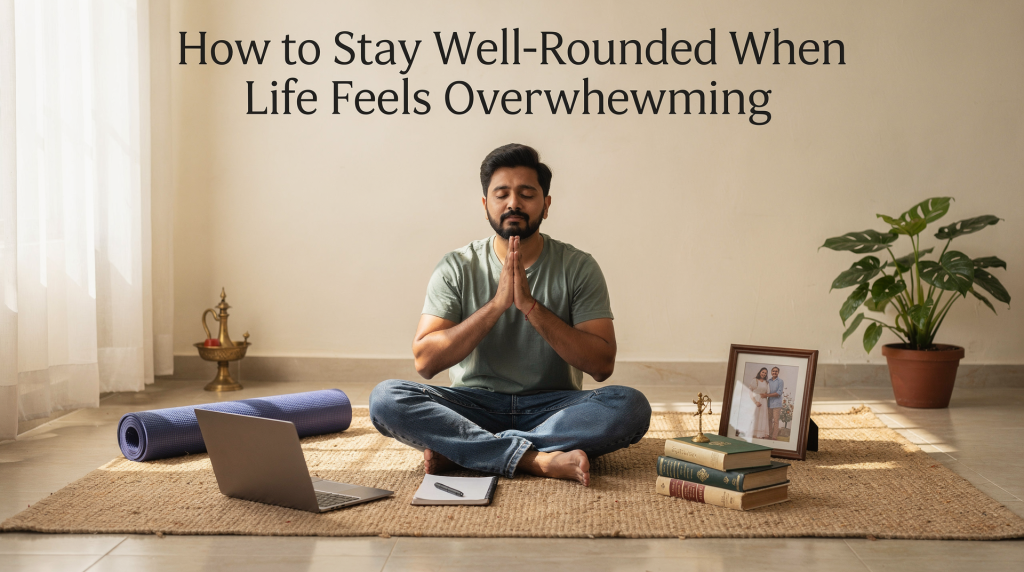
When life feels too full, staying well-rounded does not mean doing everything perfectly. It means protecting the parts of life that keep you steady: your body, mind, home, relationships, and daily rhythm. In India, where work, family expectations, traffic, noise, and constant comparison can all pile up at once, a grounded routine often matters more than a dramatic life overhaul.
The goal is not to become endlessly productive. The goal is to feel less scattered, more present, and more supported by the life you are actually living. Over years of helping people build intentional lives, I’ve seen that real steadiness comes not from heroic efforts but from small, repeatable actions that gently return us to center. And often, the first step is not adding new habits—it’s freeing up space, both physical and mental.
What “well-rounded” really means when you are overwhelmed
A well-rounded life is not about equal time in every area. That idea sounds neat, but real life is rarely balanced in neat proportions. Some weeks will be heavy on work. Some will be family-focused. Some will demand rest and recovery.
A more useful definition is this:
- You can notice when you are slipping.
- You can respond before everything collapses.
- You have a few reliable habits that bring you back to center.
- Your home and routines do not add more pressure than necessary.
That is the practical version of well-rounded living: not balance as a perfect state, but balance as a return point. In my practice, I’ve met many who believed a balanced life meant a perfectly color-coded calendar. But true equilibrium is more like an internal compass—it lets you sense when you’ve drifted and gently steer back without waiting for a crisis. And your home plays a quiet but critical role here: if your space is cluttered or inconvenient, it constantly pulls at your attention, making that return far harder than it needs to be.
Why overwhelm hits harder than it should
Overwhelm usually does not come from one big problem. It comes from accumulation.
Common triggers include:
- Too many decisions in one day
- Visual clutter at home
- Unfinished tasks sitting everywhere
- Poor sleep or irregular meals
- Too much screen time
- Emotional load from family, work, or money concerns
- A home setup that makes daily life harder than it should be
When your environment is noisy, your mind has to work harder just to function. In Indian homes, that often means shared spaces, compact layouts, multi-use rooms, and constant movement. None of that is bad. But without intention, it can quietly drain you. I’ve noticed this in my own shift from a sprawling flat to a compact apartment in Pune: the sheer volume of unused square footage and forgotten belongings had been sapping energy I didn’t even know I was spending. Once the space was right-sized, the mental fog started lifting.
The fastest way back: reduce load, not standards
When people feel overwhelmed, they usually try to “get it all together.” That often fails because it adds pressure. A better approach is to reduce load first.
Start with these three questions
- What is draining me most right now?
- What can wait for 48 hours?
- What can be simplified instead of perfected?
These questions work because overwhelm makes everything feel equally urgent. It is not. I return to them whenever I feel scattered—they cut through the noise without demanding a full life audit.
The 80/20 rule for real life
Focus on the few things that affect most of your stability:
- Sleep
- Food
- Movement
- A reasonably clear space
- One or two supportive relationships
- A basic daily structure
If those are shaky, almost everything else feels harder. I’ve watched clients regain clarity simply by protecting sleep and clearing a single surface. These fundamentals are the floor under your feet; when they’re solid, the rest becomes manageable.
A grounded reset you can do in 15 minutes
You do not need a full weekend retreat to feel better. You need a reset that works on an ordinary day.
1. Clear one surface
Choose one visible area:
- Dining table
- Bedside table
- Kitchen counter
- Work desk
- Sofa side table
Remove anything that does not belong there. Do not reorganize the whole room. Just restore visual calm. This micro-downsizing act is something I practice daily—it instantly lowers cognitive load, a lesson my compact Pune home reinforces every morning.
2. Drink water and eat something simple
Overwhelm gets worse when you are dehydrated or underfed. Have something steady and familiar:
- Fruit
- Curd and rice
- Toast and eggs
- Poha
- Dal and rice
- A simple home-cooked meal
3. Put your phone away for 10 minutes
Not forever. Just long enough for your nervous system to stop reacting to new inputs.
4. Breathe with structure
Try this:
- Inhale for 4 counts
- Exhale for 6 counts
- Repeat 10 times
The longer exhale helps your body shift out of fight-or-flight mode. It’s physiology, not just a wellness tip—activating the parasympathetic nervous system reliably signals safety to your brain.
5. Write down the next three actions only
Not 20. Not the entire life plan. Just the next three useful steps.
Example:
- Reply to one email
- Pay one bill
- Wash one set of dishes
Momentum often returns after movement, not before it.
Your home is part of your mental state
A cluttered or poorly arranged home does not cause every emotional problem, but it can make stress harder to manage. A home that is visually loud, hard to clean, or overfilled with unused items quietly keeps asking for attention.
Minimalism in the Indian context does not have to mean bare rooms or imported aesthetics. It means removing what is unnecessary so your home supports your actual life. Square footage and rootedness are not the same thing: you can feel lost in a vast flat and deeply settled in a compact studio. After downsizing in Pune, I discovered that a smaller, intentionally arranged space gave me more clarity and far fewer distractions than my larger home ever did. The key is whether your environment reflects your real needs, not borrowed expectations.
What a supportive home looks like
- Easy to clean
- Easy to move through
- Clear storage
- Enough open space to think
- Furniture that earns its keep
- Items chosen for use, not just display
Common signs your space is working against you
- You avoid certain rooms
- Cleaning takes too long because every surface is crowded
- You buy duplicates because you cannot find things
- You feel tired just looking around
- You keep postponing home decisions because the space feels mentally heavy
If any of these sound familiar, the issue may not be discipline. It may be that your home needs simplifying. After my move, I noticed there were no more “dead zones”—every corner earned its place, and that brought a surprising lightness.
Decluttering without making it a project you hate
Decluttering works best when it is specific, short, and repeatable. Trying to “declutter the house” is too vague.
Use this method instead
Step 1: Choose one category
Examples:
- Clothes
- Kitchenware
- Books
- Paperwork
- Toiletries
- Tech cables
Step 2: Sort into four piles
- Keep
- Donate
- Recycle
- Discard
Step 3: Ask practical questions
- Do I use this?
- Do I have a better version already?
- Would I buy this again today?
- Is this item making life easier or harder?
These questions—distilled from hundreds of decluttering sessions—cut through sentimentality without dismissing it, and keep the focus on function.
Step 4: Stop when the space is clearly easier to use
You do not need to finish everything in one sitting.
What to keep
Keep items that are:
- Useful
- Frequently used
- Emotionally meaningful in a real way
- Easy to store
- Worth the space they take
What to let go of
Let go of items that are:
- Broken and unrepaired
- Duplicates you do not need
- Aspirational clutter
- Guilt-driven keepsakes
- Things saved “just in case” for years
Table: quick decisions when you feel stuck
| Situation | Best next move | Why it helps |
|---|---|---|
| You feel mentally foggy | Clear one surface | Instantly reduces visual load, freeing mental bandwidth |
| You feel physically restless | Walk for 10–15 minutes | Resets energy without needing a plan |
| You feel emotionally overloaded | Cancel one non-essential task | Creates immediate relief and reclaims a sense of control |
| Your home feels chaotic | Pick one category to declutter | Prevents random decision fatigue |
| You feel behind on everything | Write the next three actions | Turns amorphous panic into a manageable sequence |
A simple daily structure that keeps you grounded
You do not need a rigid routine. You need anchors.
Morning anchors
- Wake up at roughly the same time
- Drink water
- Open a window or step into daylight
- Avoid checking your phone immediately
- Decide the one thing that matters most today
Midday anchors
- Eat lunch without rushing if possible
- Take one short break away from screens
- Stretch or walk for a few minutes
- Reassess your task list instead of blindly pushing through
Evening anchors
- Tidy for 10 minutes
- Charge devices away from the bed if possible
- Note what can wait until tomorrow
- Shut down work mentally, not just digitally
These small anchors matter because they create predictability. When life feels unstable, predictability is a form of support. After downsizing, I found my days naturally gained structure simply because less time went to cleaning and searching for things. Anchors like these became the quiet scaffolding of my well-being.
Protecting your energy in Indian social and family contexts
In India, overwhelm often has a social dimension. There may be family expectations, frequent calls, unplanned visits, festivals, obligations, and the pressure to stay available. Being well-rounded does not mean saying yes to everything.
Helpful boundaries that still feel respectful
- “I can talk after 7 pm.”
- “I need a day to think about that.”
- “I won’t be able to attend, but thank you for including me.”
- “I am keeping this weekend quiet.”
- “Let me confirm tomorrow.”
Boundaries are not rejection. They are structure. I’ve learned to frame them as care for the quality of my presence—saying “I can give you my full attention after 7” lands differently than a flat “I’m busy.” It preserves connection while protecting energy.
If guilt shows up
Ask yourself:
- Am I saying yes out of genuine willingness or automatic pressure?
- Will this commitment leave me resentful or depleted?
- Is this mine to carry?
If the answer is unclear, pause before agreeing. So often we shoulder loads that were never ours to begin with.
When to simplify bigger life decisions
Sometimes overwhelm is not a temporary mood. It is a signal that your life setup is too large, too complex, or too expensive for the way you actually live.
That may show up as:
- A home that is bigger than you need
- A commute that drains you daily
- Too much money tied up in maintenance
- A living arrangement that does not support rest
- A city or neighborhood that no longer feels rooted
In those cases, “staying well-rounded” may require a bigger question: does your current setup still fit your life? I’ve watched people stay in oversized homes for years, the background stress of upkeep and unused rooms quietly eroding their calm. When I finally asked myself that question, the answer was clear: my spacious flat no longer matched how I wanted to live—with fewer possessions and more ease.
For many people, the answer is no.
Mindful downsizing as a grounded-living strategy
Downsizing is not failure. It is often clarity.
A smaller, more manageable space can reduce:
- Cleaning time
- Utility costs
- Visual clutter
- Maintenance stress
- Decision fatigue
It can also increase:
- Ease
- Focus
- Financial flexibility
- Emotional calm
- Time for the parts of life that matter
When I moved from a large flat to a compact apartment in Pune, cleaning time halved, bills dropped, and the nagging sense that my home was “demanding” constant attention disappeared. In its place came a feeling of rootedness: fewer square meters, but a deeper connection to the space. Downsizing is not about deprivation; it’s about intentionally choosing an environment that supports your life instead of complicating it.
Before you downsize, ask:
- What do I actually use daily?
- Which rooms or items create stress?
- What would I lose if I had less space?
- What would I gain if my home felt simpler?
The point is not to live with as little as possible. The point is to live with enough. Enough is a deeply personal measure, and it rarely matches society’s blueprints.
A practical weekly reset checklist
Use this once a week, ideally on the same day.
- Clear one storage zone
- Wash or sort one neglected item pile
- Review upcoming commitments
- Delete unnecessary digital clutter
- Restock essentials
- Check your sleep and food rhythm
- Spend one hour without consumption, scrolling, or shopping
- Do one thing that makes your home feel calmer
This keeps overwhelm from building silently. I recommend it to anyone wanting to prevent chaos from accumulating—especially after downsizing, when clutter becomes visible faster but is also quicker to clear.
Mistakes that make overwhelm worse
Trying to fix everything at once
This creates burnout disguised as productivity.
Waiting for motivation
Most relief comes after small action, not before it.
Treating clutter as a moral failure
Clutter is usually a systems problem, not a character flaw.
Buying storage before reducing stuff
More storage often hides the problem instead of solving it. I’ve seen this pattern repeatedly—it’s like treating a symptom while the root cause remains. After my move, I realized the best organizer is simply fewer things.
Confusing busy with well-rounded
A full calendar is not the same as a full life.
FAQ
How do I stay calm when everything feels urgent?
Pause and identify the next three actions only. Then handle one at a time. Urgency feels smaller once it becomes a sequence. This method turns amorphous panic into a path your brain can follow—I use it with clients in the thick of overwhelm, and it reliably restores a sense of agency.
What is the first thing to fix when life feels overwhelming?
Start with sleep, food, and one clear space. Those three changes often improve everything else enough to think clearly. They create the physiological and psychological floor you need; without them, any other effort is like building on sand.
How much clutter is too much?
If your home is harder to clean, harder to navigate, or mentally tiring to look at, you likely have more than you need.
Can a small home support a well-rounded life?
Yes. A small home can work very well if it is organized, intentional, and aligned with how you actually live. I live in a compact Pune apartment that gives me more peace than my larger home ever did. It’s not about size—it’s about whether the space reflects your priorities, not social expectations.
Is minimalism necessary to feel grounded?
No. But reducing unnecessary items, decisions, and distractions often makes grounded living much easier.
Final thought
Staying well-rounded when life feels overwhelming is not about controlling everything. It is about removing friction where you can, protecting your energy, and making your home and routines support you instead of draining you. Start small, stay practical, and keep returning to what is essential. That’s how I build my days now—and it works, one clear surface and one deep breath at a time.